Showing posts with label 1980. Show all posts

Friday, July 20, 2012

No Direct Line From My Brain To My Heart

or
Langhoff Unpublished: Proposal to write a 33 1/3 book about Half Japanese's 1/2 Gentlemen/Not Beasts (Even in rejection, they are very pleasant and polite, and Jad has been very kind.)


The album starts with a cymbal and a snare -- on the beats, keeping the pace, firing off a martial 16th-note rhythm, funk as though conducted by a drum major. Second time around someone -- a cat? a vibration in the air? -- starts messing with a guitar. Third time around the guitar explodes.

Not literally; that’d make for a very short song, and Half Japanese’s “No Direct Line From My Brain To My Heart” lasts all of two minutes. No, there’s definitely a human manipulating strings here. That said, David Fair’s guitar explosion differs from, say, Jimmy Page’s riff in Led Zeppelin’s “Communication Breakdown”, or even from Ron Asheton’s elongated howls in the Stooges’ meltdown “L.A. Blues”. Those explosions intimate a chaos in the air, threatening, storm clouds gathered and relative humidity 100%, but our faith in the players’ skill keeps the storm right on the edge of possibility. In the hands of a skilled player, guitar chaos can maintain 100% humidity for minutes at a time, threatening torrents without actually breaking down into a deluge. Such implied chaos is thrilling and it makes your hairs prick up.

David’s guitar on “No Direct Line” washes away any threat or thrill. The guitar part doesn’t know what it’s doing, so it tries to do everything, changing too much to be a riff but repeating itself too much for a solo. Notes land on the beats or maybe not, mostly as anticlimactic fills in the spaces between David’s shout-singing. Though the decisions governing David’s note choices remain obscure, he keeps droning back to a G-sharp and its lower A. These two notes would outline a lovely four-major-seven chord in the guitar beginner’s key of E, but here’s the thing -- we have no idea how, or whether, David tuned his guitar. To be fair, David’s got music theory on his side. From his manifesto “How to Play Guitar”: “Tuning the guitar is kind of a ridiculous notion. If you have to wind the tuning pegs to just a certain place, that implies that every other place would be wrong. But that absurd. How could it be wrong? It’s your guitar and you’re the one playing it.”

To end the song, David and his funky drummer, younger brother Jad Fair, speed up and play a barrage of fast, dry notes. (David again: “If you want to play fast move your hand fast and if you want to play slower move your hand slower.”) David’s grand finale is that same G-sharp we’ve been hearing throughout the song, followed by the low E an octave down. Resolution! Although in context the note sounds just as random as all the others; only the spaces around the E tell us this is the end.

If the guitars of Page and Asheton were sustained storm warnings, David’s guitar is your damp and crummy life after the deluge. A while back, after a summer storm had knocked out most of our county’s power for days, people began to notice that McDonald’s had its lights on. The place was soon full of cranky refugees, tramping mud and jockeying for outlets and Wi-Fi. If anyone bothered making eye contact, it was the blank expression of a sociopath jonesing for your seat. A revelation from the Global North: this is how the world will end. Not with neighbor helping neighbor, not even with thunderdomes or hunger games, but with slop, tedium, self-absorption, and breathtakingly inadequate customer service.

You say you want a communication breakdown? Listen to Half Japanese.

----

Specifically, listen to the Maryland band’s first album, ½ Gentlemen/Not Beasts. It’s a monument of DIY music, notoriously the only debut album that was also a three-album box set. It’s also unfathomable as a consumer product. Released in 1980 on the British upstart label Armageddon, ½ Gentlemen compiled 48 songs plus two hard-to-parse live sets from a virtually unknown band. Up until that year, the Fair brothers had recorded, taped, pressed, and sold short bursts of music through ads in places like Trouser Press and NY Rocker, rock magazines friendly to the underground. Their label 50 Skidillion Watts was basically synonymous with “self-released”, and Half Japanese was its only act. Though the band reached a surprising number of people through magazine ads, it’s not like they were part of a distribution network or sold in stores. Who did Armageddon imagine would buy their box set?

Especially when they sounded like... what? “One-take learning-our-chords musicianship and vocals that make Jonathan Richman sound like Vaughan Monroe,” suggested Village Voice critic Robert Christgau in a C+ review. “Noisesome, wild, nude, and more basic than toast... the decade’s first essential document,” remembered early supporter Byron Coley in a 1988 SPIN. “I still haven’t been able to listen... all the way through,” said the Voice’s Lester Bangs in his piece “A Reasonable Guide to Horrible Noise”, right before he praised Lou Reed’s Metal Machine Music yet again. All true except the C+!

About Bangs’s taste in horrible noise: For its reputation as unlistenable water torture, Metal Machine Music actually fades into the background very nicely. I’ve played it as a sleep aid, and an early listening experiment with my infant son did not end in tears. People are used to accepting sustained noise as art. We might not put on Krzystof Perderecki’s albums too often, but we’ve heard his music play the role of “disturbing squawl” in enough movies that it seems intentional. If your job has ever included a dot matrix printer or an espresso machine, microtonal noise violence starts making a whole lot of sense. Bangs said of MMM, “Sounded great in midwestern suburbs, but kinda unnecessary in NYC.” Take it from me -- midwestern suburbs have gotten louder.

Even so, when I first heard ½ Gentlemen in a midwestern college town, it refused to fade into the background. Refused to do much of anything, really. The album’s whole sound was one big refusal: to engage, to terrify, to learn instruments, to create a compelling reason to listen. Tripping through the canon with the aid of the SPIN Alternative Record Guide, I’d recently fallen for the guitar noise of Sonny Sharrock and Glenn Branca -- beautiful anguished jazz skronk and massed droning guitar choirs, respectively. The guide told me to buy ½ Gentlemen; the Fair brothers “seemed to take more pleasure from the acts of singing and playing than any rock band before or since,” wrote Craig Marks. So at my first opportunity I snatched up the 1993 CD reissue on T.E.C. Tones -- impressive enough, though not the original gorgeous vinyl box set -- and became thoroughly confused.

This was partly T.E.C.’s fault. My copy mixed up the labels on the two CDs, with disc A labelled “B” and vice versa. I didn’t figure this out for at least a week. At first I was never certain which song was playing. The cover of Springsteen’s “10th Avenue Freeze Out” kept yelling “I’m sorry!” Was that part of the point? Was it even supposed to be a cover?

Even after it registered that, oh yes, there was a song on disc B yelping “10th Avenue freeze out!!!” over chicken scratch guitar, confusion lingered. I also blame Education. See, I was a music student, and that junior year I’d read two mind-altering books, Greil Marcus’s Mystery Train and A Guide to Schenkerian Analysis, a textbook synopsis of the theoretical work of Heinrich Schenker. Both thinkers made me cry -- Marcus for his visionary affirmation of the rock music I loved, and Schenker because he was a didactic asshole who convinced me I was wrong about life. (Life, music, what’s the difference?) Both also made a lot of sense. But neither had anything to do with Half Japanese and all their refusals. I couldn’t imagine reading the myths of America in this anti-music, let alone deriving a convincing Ursatz.

I couldn’t even imagine deriving that most fundamental musical hook, pleasure. Sharrock and Branca may have been out there, but their guitars sang with tangible beauty and they evoked ideas beyond themselves, whether tumultuous sadness or steely superstructures. Half Japanese evoked nothing beyond two guys switching off on guitars and drums, moving their hands fast when they wanted to play fast. Their guitars sounded drab and unadorned. Maybe most important for music student me, you couldn’t tell whether they knew what they were doing. My peers didn’t always share my affection for John Cage and Public Enemy, but at least we could all agree their anti-music intended its refusals. Half Japanese made anti-music because they couldn’t make anything else. If amateurism was the point I couldn’t relate.

After listening for a while, confusing myself, confusing my roommate (who called them “those Japanese guys”), and getting totally into Rent, I filed the album away. Not for me, not now, I figured. In the years that followed I’d see ½ Gentlemen while rearranging my CD shelves and it’d remind me of college, sort of like the Schenker textbook or geopolitical board games. And then, 13 years after I’d given up on it, I played ½ Gentlemen out of curiosity for one of my favorite music fans, as another experiment, and he taught me to fall in love with it.

By then Zack had outgrown Metal Machine Music; he was four years old.

------------------

“I don’t wanna go to preschool!”

Zack and I had a routine while we drove a half hour across the county. He’d scowl out the window, sucking his thumb furiously, and repeat his refusal like a mantra. I’d ply him with questions about what he did at preschool -- “Do you eat delicious food? Do you get to ride bikes? Do you play with Logan?” -- and then ask him whether he could expect the same today. He could, we agreed, but that didn’t settle the matter.

“I don’t wanna go to preschool!”

The whole thing became a ritual of discontent and reassurance, our way of grasping the universal human realities of suffering, insecurity, and boring commutes. We had other mantras. We’d count buses; we’d remember that “IHOP” meant pancakes and “OTB” meant horses. And we’d listen to music. At the time, I was following my wife’s system of listening to my albums alphabetically, letter by letter, which had led to some surprises. Zack really liked Diamanda Galas’s hard-rock shriekfest “Skótoseme” -- “that crazy lady,” we called her at first -- but dismissed the Holy Modal Rounders, who I’d assumed (hoped?) would be a big hit.

One morning we listened to ½ Gentlemen. I’d postponed Half Japanese for as long as I could, but the H’s were drying up and my I’s were a wasteland. (Even I wouldn’t subject a preschooler to Ice Cube, and Orfeo Records’ Idolos del Rock Argentino comp isn’t as cool as you think it’d be, trust me.) Once again I’d forgotten that A was B and B was A, so instead of “No Direct Line” we heard “Funky Broadway Melody”, which has no melody. Some sources change the “Melody” to “Medley”, but it’s not one of those either.

Jad plays a muddy, mutating riff, as though he’s heard Wilson Pickett’s “Funky Broadway” and is trying to sop up every instrument’s part with his guitar. It’s a claustrophobic sound, no space anywhere. Dissonant high notes squiggle over the droning A minor riff, David hits the drums hard on the fours, and Jad yelps about dancing with a bunch of stoners, until the police show up and arrest everyone for disturbing the peace. In court, Jad tries to reason his way out of a hundred-dollar fine by explaining, “JUDGE, it’s JUST FUNKY!” The song ends with random scritches and thumps, as though guitar and drums are tumbling down a giant Plinko board. I considered turning on NPR, but curiosity got the better of me.

“What do you think of these guys?”

“Good.”

“They sound kind of silly, don’t they?”

“Can we hear it again?”

This was unexpected, but sure, we could hear it again. The second time raised some questions: “Why does Papa got a brand new bag?” “Why can’t he stand himself?” “What’s a mojo?” (The answer to each: “He’s saying what a good dancer he is.”) And during that Plinko-board ending, “What are they DOING???” (“They’re figuring out how to end the song.”) He wanted to listen to it again. Pretty soon he wanted to listen to the next song, “I’m Sorry”, and then just those two songs in a row. This lasted the rest of the car ride, and the car ride home, and then we listened to those two songs on repeat for the next few weeks, whenever we were in the car. Sometimes we’d move on to the other songs -- he insisted we endure those two interminable live sets, programmed as a track apiece -- but we always returned to “Funky Broadway” and “I’m Sorry” and our litany of questions and answers.

I didn’t understand this new ritual. Like any NPR-listening first-time parent, I tried psychoanalyzing my son. Did Half Japanese, like Where the Wild Things Are, allow him to live some vicarious savagery? Did they give him something unique to hold onto during the loneliest stretches of preschool, the nap times during which he could never fall asleep, hoping I’d appear at the door to pick him up early? My probing questions (“Why do you like these guys?”) unearthed appropriately profound answers (“I don’t know,” “Good”) and more thumb-sucking. My normally vivacious son shut down around preschool, and Half Japanese’s refusals seemed to speak to his refusals, but figuring out their shared language was like deciphering cave paintings. So we listened again.

The more we listened, the more I heard. For amateurs who didn’t know what they were doing, the Fair brothers made their songs sound wildly different from one another. If “Funky Broadway” was beginners’ funk, “I’m Sorry” was beginners’ new wave, its spiky monotone stomp evoking skinny ties and robotic dances. But here’s the other thing: after repeated listens, I was no longer certain the “amateur” tag applied. The brothers had a way with words, especially Jad, whose “It happened on a MONday! / On a MONday!” tag in “I’m Sorry” was as catchy as anything on oldies radio. The brothers’ guitar maximalism made up for what they lacked in precision -- Jad’s riff plus lead lines in “Funky Broadway” reminded me of Robert Johnson only, you know, dissonant. (Which may have made them more interesting, actually.) As we ventured into the rest of this vast album -- into covers of Dylan and Buddy Holly, minimalist electro-acoustic instrumentals, multiple versions of the same songs -- it felt unfathomable again, but musically unfathomable. Was there a bottom to this thing?

My boy eventually graduated preschool. He loves school and Star Wars and Lady Gaga, but he still likes to put on ½ Gentlemen from time to time. Me too. His fandom gave me the great gift of appreciation, and like any monumental artwork that we learn to appreciate, ½ Gentlemen has altered my outlook on music and life (what’s the difference?) in a bunch of little ways, maybe even in some big ways, but certainly in unpredictable ways. No direct line from my brain to my heart, indeed. This is appropriate, since ½ Gentlemen is itself a work of and about fandom. The Fair brothers wrote songs about their favorite musicians -- Patti Smith, Yoko Ono, the Shaggs, and, in a very conflicted way, the Beatles. In fact, you can read this album as an ode to fandom, an epic about coming to terms with the tropes and heroes of rock ‘n’ roll. It’s got father-killing, anxiety of influence, and lots and lots of girls.

First, though, you have to learn how to read it.


Chapter 1: Battle of the Bands
(The Songs)

Chapter 2: Bogue Millionaires/Cool Millionaires
(Selling Noise Pt. 1)

Chapter 3: Till Victory
(Selling Noise Pt. 2)

Chapter 4: Shy Around Girls
(Indie Rock Romance)

Chapter 5: Rave On
(Fandom)

Chapter 6: No More Beatle Mania
(Punk and Tradition)

Chapter 7: Tangled Up In Blue
(Finale)

Wednesday, April 27, 2011

The recent Bob Marley live album MAY be Worth It.

 
Oddly enough, Surfing in Babylon has never really considered Mr. Marley, even though he's a cornerstone of the Babylon Symbol Repertory. This PopMatters review does little to correct that, but it may provide food for future thought, if indeed Surfing in Babylon ever gets back to studying Babylon songs. Sample paragraphs:

And for those who’d complain that Marley sings everything the same way—well, that’s sort of the point. He delivers the tender “No Woman No Cry” with the same stern deliberation he gives the militant rhetoric in “War”. “No Woman” is maybe a little more legato, but the briskly enunciated “cornmeal porridge” line and the chanted “everything is gonna be alright” belong to the same worldview as H.I.M. Haile Selassie’s powerful “War” speech. You buy Marley’s messages of hope because they don’t turn him all lovey-dovey. He remains a clear-eyed revolutionary, a powerful dude you don’t wanna mess with even when his lyrics and band are giving you a musical hug.

Marley’s straightforward messages gain depth through juxtaposition in the setlist. “Everywhere is war” is one thing, but it becomes something else butted up against “we don’t need no trouble; what we need is love”. And that medley becomes something else again as a prelude to “Zimbabwe”, a call for armed revolution in the African nation. Six months before this show, the revolutionary leader Robert Mugabe had been elected prime minister of Zimbabwe, and the song sounds like a thoughtful celebration. 30 years later, Mugabe has a reputation for incompetence and brutality, but Marley’s songs sound as true as ever. The lesson for you kids: write songs, protest, but don’t go into politics. Seriously, have you looked at the news lately? EVERYWHERE is war.

Tuesday, May 25, 2010

Best Thing I Heard Today: Iron City Houserockers doing "We're Not Dead Yet"


If you're analyzing the decline of MySpace, look no further than this damning sentence:

"We're sorry but we didn't find any results for 'Iron City Houserockers' when we searched in Music on MySpace."

As any presidential candidate could tell you, you can't win if you don't suck up to Pennsylvania! To be fair, Pittsburgh's favorite son and Houserockers leader Joe Grushecky does have a myspace of his own; but to get the full story, you have to hear this band. More and more, it's looking like you have to scrounge around in used vinyl bins to do so. (Or you can buy remastered CDs, yes. That's the best way to make sure Grushecky gets paid.)

"We're Not Dead Yet" depicts the Houserockers raging against the dying of the light with fire and panache. Since that particular song is dead to the Internet, here's "Junior's Bar" instead. It depicts a desperate loser trying to score with a 17-year-old, with anything BUT fire and panache.


Grushecky was and may still be a special-ed teacher in Pittsburgh, probably an even tougher job than trying to make it in the music biz. (He's also still making well-received music.) The Houserockers were on MCA and came tantalizingly close to hitting it big, but got dropped after three albums. They were sort of the missing link between two strains of drinking rock: the new-wave British pub-rock of Graham Parker, and the throwback American bar-rock of Springsteen. Their second album, Have a Good Time But Get Out Alive!, pulled those strains together with production by Springsteen sidekick Steve Van Zandt and glam hero Mick Ronson, among others. Grushecky sang with the passion of all those guys, and he wrote some really good songs to boot.

Chuck Eddy on the Houserockers: "Listening to radio in Detroit in 1980, I deduced that Iron City Houserockers' blues-rock was new wave and Herman Brood's blues-rock wasn't, but history proved me wrong on both counts."

And Jimmy Guterman: "All [the Houserockers'] characters... end up crushed, muttering warnings for those about to face the wheel. This bloodied defiance linked the Iron City Houserockers to punk..."

Friday, May 21, 2010

Best Thing I Heard Today: LiLiPUT doing "Die Matrosen"


The Boy and I spent an enjoyable morning watching a DVD of vintage LiLiPUT TV clips, released a couple months ago on Kill Rock Stars. LiLiPUT were a Swiss lady band, late-'70s/early-'80s, who had to change their name from Kleenex when Kimberly-Clark started gettin' litigious. "Die Matrosen" features some almost-in-tune sax along with whistling(!), and nearly all their tunes have cool little FX like that. (I actually prefer their song "Split," which hails from the same album as "Matrosen" and features an elaborate vocal arrangement celebrating hopscotch and hara kiri; unfortunately, Youtube seems to disagree with me.) Those sound effects probably constitute much of the band's appeal to a four-year-old, along with the visuals on the DVD and the fact that their music is impossibly cheerful.

(Greil Marcus on "Hedi's Head," another impossibly cheerful number: "The feeling of people breaking loose is irresistible: they sound like ten-year-olds manically cutting up their Barbie dolls.")

Tuesday, April 20, 2010

Surfing With Culture


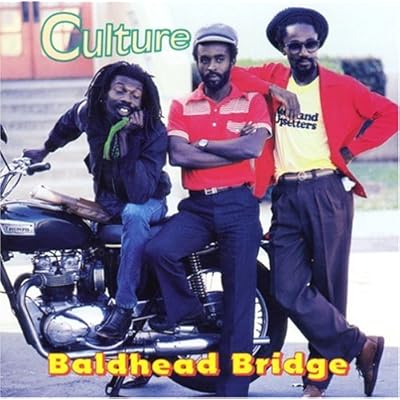
Culture seem like a good entry point into discussing the Babylon symbol as it's used in reggae. After all, they have NINE songs with Babylon in the title, and plenty more that contain Babylon deep within their grooves and words. In reggae, the Babylon symbol is always present, if only between the lines, and its meaning is pretty consistent--it's the system that's opposed to the will of Jah, and that keeps Jah's people (the Rastafari) from fully experiencing the divine life. Reggae is more nuanced when it asks the question, "Given its existence, what do we do about Babylon?" Joseph Hill, Culture's head honcho and chief lyricist, railed against the symbol in various ways, so Culture's stuff can serve as a lens through which to view the rest of reggae's "Babylon" symbology. It's not an exhaustive lens, but a useful one nonetheless.

Their earliest Babylon song (going just by songs with "Babylon" in the title) was 1978's "So Long Babylon a Fool I (and I)", from the album Baldhead Bridge. To my ears, it's also their best--a slow elegy based on the older Nyabinghi drumming style, with some gentle horn and organ lines drifting along. (Nyabinghi drumming is built around three drums: the low Thunder, hitting on one and three; the mid-ranged Funde, sounding like a heartbeat; and the high Repeater, the song's lead instrument, improvising throughout. You can hear 'em all in this song! More familiar reggae beats and instrumentation grew out of this configuration.)


Lyrically, "So Long" has an ambiguous double-meaning. Sometimes Hill uses the title phrase to mean "farewell, auf wiedersehen, adieu"; sometimes he means, "MAN, we've been stuck in Babylon a long time!" He'd echo this theme of leaving in 2000's "Nah Stay Inna Babylon," and the "leave Babylon" strategy has been operative since the time of Marcus Garvey's Black Star Line (or since Israel's exile, depending how far back you wanna go). So there's one option.

Another option, also considered by Culture, is to "chant Babylon down." They advocate this move in 1997's not-so-ambiguously-titled "Chant Down Babylon," and also 1979's "Blood Inna Babylon." Note that they never advocate direct violence, and indeed I can't think of any reggae songs that do, though I'm sure they're out there. (Leave your requests and dedications in the comments, please!) Instead, Rastas tend to go for non-violent options. "Chanting down" is popular, and recalls Joshua circling the walled city of Jericho (though of course Joshua also proved to be a non-non-violent genocidal maniac). The chanting can also refer to calling down curses upon Babylon, as in "Blood": "I hail if Babylon kills one more Rastaman, I say / The sun will stop from shining / The grass will stop from growing." So ending Babylon is something we do, but we do it through Jah's hand.

If those don't suit ya, you can always simply MOCK Babylon. This seemed to be Hill's M.O. in the '80s, with 1980's "Babylon Can't Study" (...the Rastaman because he's bigger than Babylon) and 1982's "Babylon's Big Dog." Here's an interview with Hill that explains the inspiration for the latter tune:

“Well 'Babylon Big Dog' is a song created from the
unnecessary worries that babylon gives me. It's like I
was coming from a place in Jamaica called James
Mountain, in a very old car belonging to one of my
brethen called brother Honey... Instead of coming in, in peace, there was a
murder somewhere down the road. And then we realised
that Babylon [THE MAN] and his big dog [A COP] was there. As we pass
through, babylon tried to catch us, but this old car
was modified, and was too fast for them... So while we was
chasing away from babylon, I just start singing the
song and brother Honey crouch over the steering wheel
and start pushing the old car down," Joe laughs again.
"And they never catch us. So it really means it was
making me feel more victorious making the song triumph
over them."


And then sometimes you can simply ride it out. I'm thinking of '96's "Down In Babylon," which isn't so much about Babylon itself, as it is a lament for any sort of stable resistance to Babylon. Around a plaintive trombone solo, Hill asks, "Where are all the Rastamen who used to teach human rights and stand upright and lead and feed our nation?" [I paraphrase.] This presupposes that we're staying in Babylon, at least for the time being, and are organizing systems of our own to help bring about a society that Jah would like better.

(I'm too lazy to link to all these, but you know how to use Youtube.)

There may be other answers to the question, "What do we do about Babylon?" These four are certainly not mutually exclusive, but they also indicate that reggae answers its fundamental question more symbolically than politically. I may be wrong, but I'm not sure any reggae since Bob Marley has had measurable political effects. But that's not to say the situation's hopeless, that a symbol can't make a difference.

For one thing, the ideas of "leaving Babylon" and "chanting down Babylon" can empower individuals to change their everyday lives, even if it only means getting through the day a little happier. And for another thing, these symbols aren't just PREscriptive, they're also DEscriptive. Trevor McNaughton of the Melodians told me a couple years ago, "Babylon fall every day, man." You see this in every act of justice, whether it's one person sitting down to a meal with a homeless guy, or the SEC fining archenemies-of-the-people Goldman Sachs. God's/Jah's Kingdom breaks in where it will, and we do what we can to hasten it.

And in the meantime, Joseph Hill would advise, we can make fun of Babylon as we ride it out.

Monday, January 25, 2010

Best Thing I Heard Today: Brad Paisley doing "Then" (and also Change doing "The Glow of Love")


Hearing "Then" on the radio today, I realized the song is kind of about itself, at least in my world. That is, it keeps growing on me, and that's after I voted for it in a year-end poll, and after I've stuck up for it over on ILM's Rolling Country thread. But today it was even more touching, relatable, and perfect, like an image of my life here in Two-Thousand and Ten, so I thanked the song and said, "And I thought I loved you then." (This increase in love is kind of a relief, proof to myself that I didn't overrate it.) By all means click and listen:


"Then" is better than most sappy prom ballads, in part because its verse melody sets the song up to be in a minor key, which is unusual for a happy song. The minor opening gives the song some additional depth. It creates a wistful tinge of longing and maybe even uncertainty--is this going to be a sad song? Does she get run over by a train or something? But once we get to the soaring major chorus and we realize everything's OK, Brad Paisley's love sounds even happier for having made it through the minor-ness.

In 1980, Change's song "The Glow of Love," featuring Luther Vandross's first prominent lead vocal, employed a similar happy-minor strategy. This song's even better than "Then," and notice how the first three notes of their piano riffs are the same (5,3,2). Coincidence? Yeah, I'm sure it is.


On Youtube, the Change comments are mostly music-related; they talk about how great Luther was, and how great Michael Jackson was (sister Janet sampled "The Glow of Love" in "All For You"). The Brad Paisley comments, on the other hand, are mostly shout-outs and dedications, tributes to real life love and how people use this song in their actual lives. Will we still be using it in 30 years? "Then" is so perfectly crafted, it should be sturdy enough to survive, no problem.

Sunday, January 03, 2010

Best Things I Heard Today: Don Williams's "I Believe in You" VS. Savage Garden's "Affirmation"


"Best" with reservations, maybe--more on those in a moment. (They concern the lyrics.) But the tune's unforgettable, the bass sound is big, the pedal steel sounds like a synth (unless that's a synth?), and Mr. Williams's delivery is laconically intense, if such a thing is possible. Here he is on Hee Haw:


Yeah, about those lyrics. Don Williams offers us a belief system, cunningly presented through a dogmatics of disbelief. Perhaps he's been reading this book (I know I haven't!):


A dialectic: Don Williams explains what he doesn't believe in, and then what he does believe in, so we get a better sense of what's going on inside Don Williams.

So what does Don Williams believe in? Unfortunately: babies, children, and old folks. What does that mean, exactly? He believes they exist? That can't be it, because he doesn't believe in organic food and foreign cars, the existence of which only a fool would deny.

So maybe he believes that babies, children, and old folks have something true and important to tell us about life and the world. Well, I don't know about that either. Have you ever met a baby? I say this with all the greatest love for my own son, and with the acknowledgment that kids have a remarkable capacity for faith and love, but KIDS ARE NOT FUNDAMENTALLY GOOD. Not even babies! They're selfish little parasites, endowed by natural selection with the cunning and will and cuteness to get what they need to survive into adulthood, at which point they have the luxury of acting on more altruistic ideals. You can call this "original sin" if you want, but just because kids aren't smart enough to break the 10 Commandments or whichever checklist you like to use, doesn't make them "innocent" or "sweet" or anything. There's a reason we tell adults not to act like children--it's because children don't act all that great to begin with.

Rather than move on to insulting all the old folks in my life, I'll just say that, for all of Don's spiritual insight in verse 2, I wish he didn't slip into this tired glorification of babies. Sure, you need "faith like a child" and whatnot, but that's a symbol of one specific aspect of children's behavior--their natural, unforced faith--and not a glorification of childhood or infancy as some ideal state of being. This "belief in babies" recalls another lyrical howler, from Savage Garden's "Animal Song": "Animals and children tell the truth, they never lie." Where are they? Where are these children who never lie?! And what about those moths that make themselves look like wasps?!!!!??

Ahem. As it happens, Savage Garden also have a musical dogmatics of belief, entitled "Affirmation." From the same album, in fact! Enjoy, and then we'll figure out a creed to incorporate both the Garden and Don Williams. The Savage Williams Creed, we'll call it. (Do Creed have any songs like this?)


Well, I don't wanna spend too much more time on this, but a couple notes:

Savage Garden are sometimes as softheaded in "Affirmation" as they were in that line about animals and children. I note particularly "the struggle for financial freedom is unfair"--not sure I agree with it, since all of life for most everybody (INCLUDING animals and children and maybe millionaires) is a struggle. (Savage Garden themselves struggle with English when they sing "the grass is no more greener on the other side.") Which isn't to say we shouldn't struggle for financial freedom. By all means, struggle and manipulate laws to take money from the privileged classes! That's what politics is all about.

Meanwhile, Mr. Williams does not believe "that gasoline's in short supply, the rising cost of getting by." Does this mean he does believe inflation and income are rising at equal rates? That gas prices are high because of futures speculation or OPEC manipulating the market? Does anyone remember what gas prices were like in 1980?

But forgive me, I must go. If anyone wants to convene a credal conference to work out a Savage Williams synthesis, let me know.

Tuesday, December 08, 2009

Best Thing I Heard Today: Hawkwind doing "Motorway City"


I'm tagging this "metal" because they're in Martin Popoff's books, but this tune is more thud-prog meets Krautrock (a term I use with impunity, thanks to my heritage) (Did you hear about the new German microwave? Seats six!). Great solo at about 3:00 or so, and the fadeout jamming is just as motorik as anything by Neu--with Ginger Baker on drums, no less!


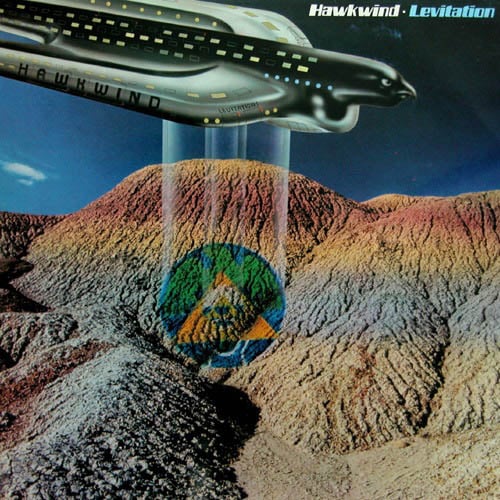
Someone had a good time making the Youtube video, too! I'm not quite sure about the cover, though--what exactly is the HMS Hawkwind beaming down onto the mountains? It looks like something Dan Brown would recognize.