Fans of low-budget horror take note: "The Awakener" is worth listening to for the thick guitar tone alone, but really, YOU NEED TO WATCH THE VIDEO:
This song comes as a melodic respite in the middle of Kataklysm's WORTH IT album Temple of Knowledge, which has something to do with the convergence of all knowledge and power, whether divine or infernal, in the year 1999 (WHICH IS 6661 UPSIDE DOWN whoa) at the top of Sigourney Weaver's apartment building.
At least I think -- one of the songs is about beckoning Xul. Really, it's better if I don't try to parse a song with couplets like
9 distincted letters were granted into a Word of Sovereignty Then was graphed the 1st of the 9... Gates of Kataklysmity But the video! The video seems to concern one of those umpteen infernal powers possessing a pretty lady who emerges from a sand dune, only she resists his demonic tendrils, causing his rubbery flesh to smoke and bake. Hairy Sylvian carries a torch, perhaps for the pretty lady, and mutters incantations with his eyes rolled back, while guitarist Jean-Francois whips his hair in the outline of a pentagram. I'm pretty sure listening to this stuff is like playing Bloody Mary in front of the mirror, but you can't beat their maniac energy.
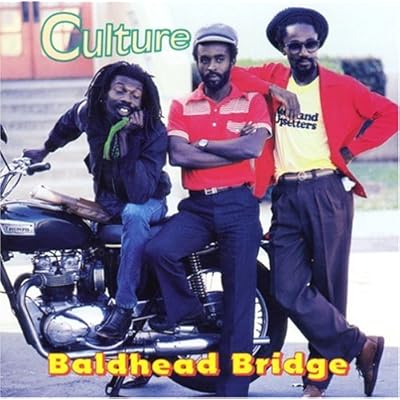
Culture seem like a good entry point into discussing the Babylon symbol as it's used in reggae. After all, they have NINE songs with Babylon in the title, and plenty more that contain Babylon deep within their grooves and words. In reggae, the Babylon symbol is always present, if only between the lines, and its meaning is pretty consistent--it's the system that's opposed to the will of Jah, and that keeps Jah's people (the Rastafari) from fully experiencing the divine life. Reggae is more nuanced when it asks the question, "Given its existence, what do we do about Babylon?" Joseph Hill, Culture's head honcho and chief lyricist, railed against the symbol in various ways, so Culture's stuff can serve as a lens through which to view the rest of reggae's "Babylon" symbology. It's not an exhaustive lens, but a useful one nonetheless.
Their earliest Babylon song (going just by songs with "Babylon" in the title) was 1978's "So Long Babylon a Fool I (and I)", from the album Baldhead Bridge. To my ears, it's also their best--a slow elegy based on the older Nyabinghi drumming style, with some gentle horn and organ lines drifting along. (Nyabinghi drumming is built around three drums: the low Thunder, hitting on one and three; the mid-ranged Funde, sounding like a heartbeat; and the high Repeater, the song's lead instrument, improvising throughout. You can hear 'em all in this song! More familiar reggae beats and instrumentation grew out of this configuration.)
Lyrically, "So Long" has an ambiguous double-meaning. Sometimes Hill uses the title phrase to mean "farewell, auf wiedersehen, adieu"; sometimes he means, "MAN, we've been stuck in Babylon a long time!" He'd echo this theme of leaving in 2000's "Nah Stay Inna Babylon," and the "leave Babylon" strategy has been operative since the time of Marcus Garvey's Black Star Line (or since Israel's exile, depending how far back you wanna go). So there's one option.
Another option, also considered by Culture, is to "chant Babylon down." They advocate this move in 1997's not-so-ambiguously-titled "Chant Down Babylon," and also 1979's "Blood Inna Babylon." Note that they never advocate direct violence, and indeed I can't think of any reggae songs that do, though I'm sure they're out there. (Leave your requests and dedications in the comments, please!) Instead, Rastas tend to go for non-violent options. "Chanting down" is popular, and recalls Joshua circling the walled city of Jericho (though of course Joshua also proved to be a non-non-violent genocidal maniac). The chanting can also refer to calling down curses upon Babylon, as in "Blood": "I hail if Babylon kills one more Rastaman, I say / The sun will stop from shining / The grass will stop from growing." So ending Babylon is something we do, but we do it through Jah's hand.
If those don't suit ya, you can always simply MOCK Babylon. This seemed to be Hill's M.O. in the '80s, with 1980's "Babylon Can't Study" (...the Rastaman because he's bigger than Babylon) and 1982's "Babylon's Big Dog." Here's an interview with Hill that explains the inspiration for the latter tune:
“Well 'Babylon Big Dog' is a song created from the unnecessary worries that babylon gives me. It's like I was coming from a place in Jamaica called James Mountain, in a very old car belonging to one of my brethen called brother Honey... Instead of coming in, in peace, there was a murder somewhere down the road. And then we realised that Babylon [THE MAN] and his big dog [A COP] was there. As we pass through, babylon tried to catch us, but this old car was modified, and was too fast for them... So while we was chasing away from babylon, I just start singing the song and brother Honey crouch over the steering wheel and start pushing the old car down," Joe laughs again. "And they never catch us. So it really means it was making me feel more victorious making the song triumph over them."
And then sometimes you can simply ride it out. I'm thinking of '96's "Down In Babylon," which isn't so much about Babylon itself, as it is a lament for any sort of stable resistance to Babylon. Around a plaintive trombone solo, Hill asks, "Where are all the Rastamen who used to teach human rights and stand upright and lead and feed our nation?" [I paraphrase.] This presupposes that we're staying in Babylon, at least for the time being, and are organizing systems of our own to help bring about a society that Jah would like better.
(I'm too lazy to link to all these, but you know how to use Youtube.)
There may be other answers to the question, "What do we do about Babylon?" These four are certainly not mutually exclusive, but they also indicate that reggae answers its fundamental question more symbolically than politically. I may be wrong, but I'm not sure any reggae since Bob Marley has had measurable political effects. But that's not to say the situation's hopeless, that a symbol can't make a difference.
For one thing, the ideas of "leaving Babylon" and "chanting down Babylon" can empower individuals to change their everyday lives, even if it only means getting through the day a little happier. And for another thing, these symbols aren't just PREscriptive, they're also DEscriptive. Trevor McNaughton of the Melodians told me a couple years ago, "Babylon fall every day, man." You see this in every act of justice, whether it's one person sitting down to a meal with a homeless guy, or the SEC fining archenemies-of-the-people Goldman Sachs. God's/Jah's Kingdom breaks in where it will, and we do what we can to hasten it.
And in the meantime, Joseph Hill would advise, we can make fun of Babylon as we ride it out.
Over three verses, Andre and Big Boi detail some of their relationships with women and then explode the meanings of those relationships into world-historical philosophical musings, sort of like how Jack and Diane sucking on a chili dog and talking about running off to the city becomes "Life goes on long after the thrill of living is gone." And I can't claim this song makes a whole lot more sense than "Jack and Diane," either. But it's inescapable once it's in your head.
In verse one Andre talks about being a crack baby (actually cocaine baby), then about the cattiness of women who won't even give him back rubs; then he disses the powers that manufacture guns while they simultaneously criticize rap music for its violent imagery. I think. Remember, this is PERCUSSION-EFFUSIVE, so meaning is secondary. But then we get the sadsoul chorus:
"Ooooh, I fear the battle's just begun Ooooh, though we're here someday we will be gone so i'm hopin, wishin, prayin to keep my faith in you, in you"
What battle? The battle for life? For learning to deal with being born a crack baby? For living in a world that's an inescapable web of violence and not getting what you want or need, and being unable to even distinguish what you want (back rubs from women) from what you need (a society without gats, the freedom to speak truth)?
And then we're back to the second verse! Which is all about dry humping in the woods during P.E. class! With... the squirrels? (It does rhyme with "girls".) Fun stuff, but the point of the verse seems to be the last couple lines, "They call it 'horny'/ Because it's devilish/ Now see we dead wrong." So Andre, because of his Adventist upbringing or whatever, feels guilty about his lust, and his lust is also part of this "Babylon."
Big Boi gets verse three, which is about his estrangement from "Rene" and people criticizing his lyrics for promoting violent crime, when in fact the violent crime and sex trade have been around since people could write, and probably before. And then he talks about the "pinks" who "moved in"--gay people? So to recap: characteristics of Babylon include drug-addicted babies, girl troubles, stifling of creative expression, violence in society, stifling of creative expression BY those who create the violent society, lust, estrangement from other people, and societal ills like drugs and prostitution, especially when you get blamed for them.
The song's borderline incoherence works to its favor in this sense: it convincingly depicts the desperation you feel when you have to deal with a problem so huge that you can't break it down, you can't separate the parts that are urgent from those that are inconsequential. And since it's a Babylon Song, Babylon seems to be the inescapable web of societal and personal ills that we can't break away from. If that's so, it's similar to reggae's Babylon--the web of civilized evil that staves off the Kingdom of God.
The chorus's simplicity settles the seeming randomness of the verses. Never mind that we don't know what the "battle" is, or even in whom the singer (Andrea Martin) is trying to keep her faith. She sees into the abyss--"though we're here someday we will be gone" (which, if you really UNDERSTAND it, is pretty much the deepest thing you can understand)--and expresses her "ultimate concern" (as dead theologian Paul Tillich would say). Unlike some Rastas (but like some others), Outkast aren't worried about "chanting down Babylon" here; they just have faith. For all they know, Babylon'll go on forever, but they'll still have faith. And that faith can be defined as "ultimate concern", NOT "expectation that Babylon will meet a sticky end at God's hand."
Babylon's overwhelming litany of sin either blinds you from your ultimate concern or--more interestingly--pushes you into your ultimate concern. Without Babylon, would faith be as accessible, or even possible? The chorus comes as a relief from the verses, because its meaning is less convoluted, and also because its musical style is much more straightforward. (NOTE: THIS IS WHERE I TIE IN THE MUSICAL ANALYSIS!) The chorus is sung, it sounds like a slow beautiful gospel song, nothing tricky to it, whereas the PERCUSSION-EFFUSIVE verses are full of weird rhythmic figures and oddly accelerated syllables, making us listeners uneasy and disoriented. Seriously, don't listen to the verses while you're on your feet, or you'll bump into walls! On the other hand, if you fall down during the verses, Ms. Martin's refrain will help you figure out where you are, and might give you what you need to rise again.
In honor of RZA's recent media tour to support his new tome The Tao of Wu, and in honor of Raekwon's new sequel to Only Built 4 Cuban Linx, which I was somehow unable to find at either Borders or Best Buy, a shameful disgrace for brick/mortar retailers everywhere, The Flowtation Device would like to present a celebration of RZA's verse from "Wu-Gambinos" off the FIRST Cuban Linx, contrasted with an exploration of Outkast's "Babylon," which is right at home on this blog and will probably be thematically explored here sometime soon.
In other words--Welcome back to some esoteric horseshit! Exhibit "A" will be Andre's second verse in the Outkast song "Babylon," from ATliens '96. Exhibit "B" is Big Boi's verse from the same song. Both exemplify what world-historic hip-hop scholar Adam Krims calls "percussion-effusive" flow (Major Tom, iz you IN DA HOUSE????) [caution: I no longer get that joke], which basically means the rhymes don't occur at regular intervals and the words conform to the rhythms, not vice-versa. Both also employ triplets and 16th notes, indicated here with italicized words. (If you see two syllables joined by italics, they're 16th notes; if you see three syllables joined by italics, they're a triplet.)
The best example of words-conforming-to-rhythms is in Big Boi's verse. Big Boi uses fairly regular triplet rhythms alternating with straight 8th beats: "AUNTiewasTIGHTlikeSOUTHwesssst-be / FOREthePINKSmovedIN.LIKEthe / NIGgaswhoOWNEDtheLIQUourSTORES. / CRACKcoCAINE.PIMPSandWHORES. / LIVin'upONthisEARTHbeFOREa / NIGgaLIKEdadDYwasBORNbut /"
Andre's verse is less regular, but still sounds like curlicued and filigreed antique furniture.
RZA's verse on Raekwon's "Wu-Gambinos" (Only Built 4 Cuban Linx, '95) is the klassic Krims example of "speech-effusive," which basically means the rhymes don't occur at regular intervals and the rhythms conform to the words, not vice-versa. RZA's verse was much harder to analyze rhythmically. All these guys have some ambiguity in their rhythms--they'll attack words ahead of or behind the beat or whatever--it's like comparing a transcribed Wynton Kelly solo to what Wynton's actually playing--but RZA was totally rushing words and employing septuplets or some shit. (As payback, I totally gave up trying to figure out the penultimate line. My payback's a mutha.)
Perhaps paradoxically, the Outkast verses that focused on rhythms-over-words were much easier to comprehend than the RZA verse that focused on words-over-rhythms. I'll get down to brass tacks on the Outkast verse in a blog or two, but just reading it you can understand what they're talking about. But I have no idea what the shit RZA is talking about, except that he's awesome and he will harm me. Perhaps also paradoxically, I like his verse better than the Outkast verses, and I'm not just saying that because he'll break 206 of my bones and watch my ass get blown into a sea of fire and brimstone. His flow's livelier and looser and he covers a lot of lyrical ground. During the span of his verse he is a dapper diamond thief, a cop, a thug, Noah Bean (the actor from Damages? not in '95...), a Klan Wizard, a Revolutionary War soldier, a doctor, and a Genie inside the Bottle that is the Projects. Where Outkast sound kind of bottled by their rhythms, RZA's a total genie on the rampage.
(Not to dis Adam Krims, who seems like the kind of nutty academic I can get behind--and he's certainly researched this stuff more than I have--but take his nomenclatures with a grain of salt. After all, it's not like anyone's done any subsequent research on the subject of flow, or indeed corroborated or refuted his three-fold classification system. At least, not anyone I can find. I plan to contact him once I have something intelligent to say.)
As I said, that RZA verse was way more difficult, and thus it's fairly impossible to read. My HOPE is that we'll somehow be able to detect the difference between "percussion-effusive" and "speech-effusive" just by looking at the flowtated lyrics--or at least that the flowtation will help differentiate in some way. Before we get to that, though, here's the reasons Krims gives for calling Outkast percussion-effusive and RZA speech-effusive (this is all from his invaluable book Rap Music and the Poetics of Identity):
1. Outkast are percussion-effusive because "the MC(s) rap rhythmic patterns that, if spoken American (including Ebonic) English is taken as 'natural,' could only be called, by contrast, 'stylized' or 'musical.'" (p.77)
2. Also true of Outkast: "The rhythms are rapid, often producing constant alterations between, on the one hand, groups of quick and even attacks, and on the other hand, slower and more differentiated rhythmic values..." FOR EXAMPLE: "LAID_WITHtheSQUIRrelsDURin' / Pe*.WEbe*ex / PLORin'eachOTHers'PRIvates*. /"
3. Outkast are from Atlanta, and, according to Krims, "certain over-the-top percussion-effusive styles could... be said to mark out an MC geographically, albeit negatively as "not-New York." (Not sure where he stands on Busta Rhymes, who's from NYC but to my ears is WAY percussion-effusive.) (Dude, I should TOTALLY do his verse from "Scenario" next!)
4. In re RZA's verse on "Wu-Gambinos": RZA "is capable of engaging in extreme speech-effusiveness with very little percussiveness... his delivery veritably overflows with complex polyrhythms, but in something approaching a monotone." (p.52)
5. On the difference between the two "effusive" styles, compared with the more old-school "sung" style (think Sugarhill, Beasties...): "there is... reason to associate the percussion-effusive with the sung style. The association would then pair off the more 'musical' (for current lack of a better term) manners of MCing against those closer to 'natural' speech." That is, RZA is closer to "natural" speech--his rhythms conform to his words.
Here are my preliminary insufficient findings, on how to distinguish styles of effusiveness by looking at the flowtated lyrics:
1. As Krims says, percussion-effusive lyrics will display more regular rhyme patterns, with fewer internal rhymes, than speech-effusive lyrics. Percussion-effusive lyrics are still more variable in their rhyme schemes than "sung" lyrics, but you can discern some regularity. See, for instance, Andre's "yo' blouse," "aroused," "brought up," "caught up," "girls," "squirrels." All those rhymes fall at roughly the same place in second bars, with almost no competing internal rhymes in the first bars. In contrast, RZA's verse starts off with some fairly regular second-bar rhymes, but in context they're barely distinguishable from all the surrounding internal rhymes and assonances. In the first two bars alone we have "shinin'," "blindin'," "like some," "diamonds," and "I be."
2. This is a little subjective, but it's much easier for me to recite the Outkast verses--in rhythm--from reading their flowtations, than it is to recite the RZA verse. At this point, I can't say if that's true of all speech-effusive lyrics or just this particular (insane) RZA lyric. But the percussion-effusive Outkast lyrics seem to settle in to easily-translatable musical patterns, whereas the RZA lines do NOT. Both verses feature sixteenth-beats and triplets, but maybe it's that RZA tends to have little regard for placing strong syllables on strong beats and weak syllables on weak beats. Other rappers play with syllabic placement, but they often do so for deliberate rhythmic effects that make sense MUSICALLY. RZA's verse, while awesome, makes less sense in conventional musical/rhythmic terms.
More to come, I'm sure--any input is welcome, as this is a work in progress.