Not much to say about it, except that Glenn Kaiser and band seem particularly offended by the way wealth and comfort can obscure the difficult call of the Gospel:
"Sometimes it flowed like magic The pleasure hid the flaw But oh forever tragic Him you never saw"
And if you STILL don't see Him when Babylon begins to burn, you are, apparently, toast.
Without speculating on whether their scriptural reading is correct, I will say that Rez have more room than most rockers to talk about the spiritual perils of wealth and comfort. They're the flagship band (currently on hiatus) of the Jesus People USA, Chicago's preeminent Christian commune. According to the Encyclopedia of Contemporary Christian Music, they've got some neighborhood political clout on social justice issues. They live close to poverty level and use their communal earnings to feed the poor and desperate. From their website:
"We can see only one good reason why God makes a person prosperous: so that individual's needs can be met and they can in turn give away the overflow. It is like milk and cream. Cream is the richest part of the milk. It is the top cut. When the Lord meets your needs and then gives more, that cream is not to be skimmed of the top for yourself. We should willingly think, 'Oh, I have more than I need,' and immediately distribute the overflow to others."
So I tend to give their apocalyptic diatribes a little more weight than those of Blackie Lawless. Not that Blackie doesn't rock, but I don't think their politics would sit well with him.
JPUSA also run Cornerstone Festival, coming soon to a muddy field near you! (Or not.) Watch for several bewildered Christian Rock Overviews in the alternative press! (Demon Hunter is a Christian band? Who am I thinking of?) (DEVIL DRIVER.) (Carry on.)
Culture seem like a good entry point into discussing the Babylon symbol as it's used in reggae. After all, they have NINE songs with Babylon in the title, and plenty more that contain Babylon deep within their grooves and words. In reggae, the Babylon symbol is always present, if only between the lines, and its meaning is pretty consistent--it's the system that's opposed to the will of Jah, and that keeps Jah's people (the Rastafari) from fully experiencing the divine life. Reggae is more nuanced when it asks the question, "Given its existence, what do we do about Babylon?" Joseph Hill, Culture's head honcho and chief lyricist, railed against the symbol in various ways, so Culture's stuff can serve as a lens through which to view the rest of reggae's "Babylon" symbology. It's not an exhaustive lens, but a useful one nonetheless.
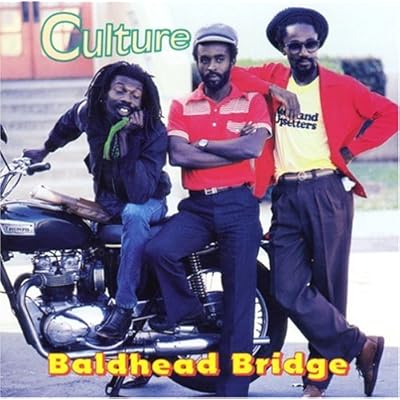
Their earliest Babylon song (going just by songs with "Babylon" in the title) was 1978's "So Long Babylon a Fool I (and I)", from the album Baldhead Bridge. To my ears, it's also their best--a slow elegy based on the older Nyabinghi drumming style, with some gentle horn and organ lines drifting along. (Nyabinghi drumming is built around three drums: the low Thunder, hitting on one and three; the mid-ranged Funde, sounding like a heartbeat; and the high Repeater, the song's lead instrument, improvising throughout. You can hear 'em all in this song! More familiar reggae beats and instrumentation grew out of this configuration.)
Lyrically, "So Long" has an ambiguous double-meaning. Sometimes Hill uses the title phrase to mean "farewell, auf wiedersehen, adieu"; sometimes he means, "MAN, we've been stuck in Babylon a long time!" He'd echo this theme of leaving in 2000's "Nah Stay Inna Babylon," and the "leave Babylon" strategy has been operative since the time of Marcus Garvey's Black Star Line (or since Israel's exile, depending how far back you wanna go). So there's one option.
Another option, also considered by Culture, is to "chant Babylon down." They advocate this move in 1997's not-so-ambiguously-titled "Chant Down Babylon," and also 1979's "Blood Inna Babylon." Note that they never advocate direct violence, and indeed I can't think of any reggae songs that do, though I'm sure they're out there. (Leave your requests and dedications in the comments, please!) Instead, Rastas tend to go for non-violent options. "Chanting down" is popular, and recalls Joshua circling the walled city of Jericho (though of course Joshua also proved to be a non-non-violent genocidal maniac). The chanting can also refer to calling down curses upon Babylon, as in "Blood": "I hail if Babylon kills one more Rastaman, I say / The sun will stop from shining / The grass will stop from growing." So ending Babylon is something we do, but we do it through Jah's hand.
If those don't suit ya, you can always simply MOCK Babylon. This seemed to be Hill's M.O. in the '80s, with 1980's "Babylon Can't Study" (...the Rastaman because he's bigger than Babylon) and 1982's "Babylon's Big Dog." Here's an interview with Hill that explains the inspiration for the latter tune:
“Well 'Babylon Big Dog' is a song created from the unnecessary worries that babylon gives me. It's like I was coming from a place in Jamaica called James Mountain, in a very old car belonging to one of my brethen called brother Honey... Instead of coming in, in peace, there was a murder somewhere down the road. And then we realised that Babylon [THE MAN] and his big dog [A COP] was there. As we pass through, babylon tried to catch us, but this old car was modified, and was too fast for them... So while we was chasing away from babylon, I just start singing the song and brother Honey crouch over the steering wheel and start pushing the old car down," Joe laughs again. "And they never catch us. So it really means it was making me feel more victorious making the song triumph over them."
And then sometimes you can simply ride it out. I'm thinking of '96's "Down In Babylon," which isn't so much about Babylon itself, as it is a lament for any sort of stable resistance to Babylon. Around a plaintive trombone solo, Hill asks, "Where are all the Rastamen who used to teach human rights and stand upright and lead and feed our nation?" [I paraphrase.] This presupposes that we're staying in Babylon, at least for the time being, and are organizing systems of our own to help bring about a society that Jah would like better.
(I'm too lazy to link to all these, but you know how to use Youtube.)
There may be other answers to the question, "What do we do about Babylon?" These four are certainly not mutually exclusive, but they also indicate that reggae answers its fundamental question more symbolically than politically. I may be wrong, but I'm not sure any reggae since Bob Marley has had measurable political effects. But that's not to say the situation's hopeless, that a symbol can't make a difference.
For one thing, the ideas of "leaving Babylon" and "chanting down Babylon" can empower individuals to change their everyday lives, even if it only means getting through the day a little happier. And for another thing, these symbols aren't just PREscriptive, they're also DEscriptive. Trevor McNaughton of the Melodians told me a couple years ago, "Babylon fall every day, man." You see this in every act of justice, whether it's one person sitting down to a meal with a homeless guy, or the SEC fining archenemies-of-the-people Goldman Sachs. God's/Jah's Kingdom breaks in where it will, and we do what we can to hasten it.
And in the meantime, Joseph Hill would advise, we can make fun of Babylon as we ride it out.
According to Rick Jackson and his nefarious "Country Hall of Fame," "Swingin'" is Anderson's signature song:
It doesn't really swing, though--lopes, struts, bounces, gallivants, rollicks, but there's no denying the fact that it's played straight and not swung. (Not that I'm complaining.) Likewise, Anderson plays his amusing story completely straight, seemingly oblivious to all the double- and triple-entendres he's pulling out of one innocent word. In that respect, Anderson's one-of-a-kind voice works to his advantage--it's so open and unusual, it allows him to play the part of The Wide-Eyed Rube while making jokes and social observations that are spot-on. (Rick Jackson and I also love Anderson's "Black Sheep." Describing his rich sister and her banker husband, Anderson sings, "They like to get together and talk about all the things they got." How perfect is that? And how many people like that do you know?)
Anyway, here's jazz critic Gary Giddins's mysterious definition of "swing": "a graceful way of advancing time that suggests ironic distance from time itself." I'm not sure how that applies to John Anderson--who is both graceful and ironic--but it's worth mulling over for the rest of the day. (For me. You don't have to mull.)
Not THOSE shepherds! Nyman originally wrote this peppy Purcell rip for Peter Greenaway's 1982 movie The Draughtsman's Contract, but we heard it last night in the 2008 documentary Man On Wire, which is fantastic, go Netflick it now. (You can stream it!) Here's the Youtube with superior sound:
When I played Nyman’s career retrospective overhead at work some years back, I got one of two responses: “It sounds like movie music.” “It sounds like Philip Glass.”
These made sense, because it was movie music, and because Nyman wrote the book, literally, on Philip Glass and his cronies (Experimental Music: Cage and Beyond), and some people blame him with first describing music as “minimalist” back in 1968.
Ever since I first heard him, though (in Greenaway’s The Cook, the Thief, His Wife, and Her Lover), I’ve heard a lunatic parody of Baroque music. Nyman’s stuff is more compact, driving, and repetitive than most movie music, and it employs Baroque circle-of-fifths ground basslines, rather than the 3 or 4-chord pop basslines of Glass’s tunes. "Chasing Sheep" features crazy horns jumping unexpectedly out of the texture on dissonant passing tones, a caffeinated pogo-stick beat, and a weird double-time “B” section, but the whole thing manages to be gorgeous anyway. Nyman’s repetition and aversion to development gives his music a static quality, which goes well with Greenaway’s contemplative, often monochromatic imagery. Be warned: after it loses the Baroque edge a quarter-way through, Nyman’s 2-disc retrospective goes downhill, with only a couple minimalist-y exceptions along the way. (He also wrote some more generically pretty stuff for The Piano.)